I have been thinking about a woman I met in Mogadishu two years ago. She had walked two days to reach a training session on drought-resilient seeds. When I asked her what worried her most, she did not say rainfall. She said the road home.
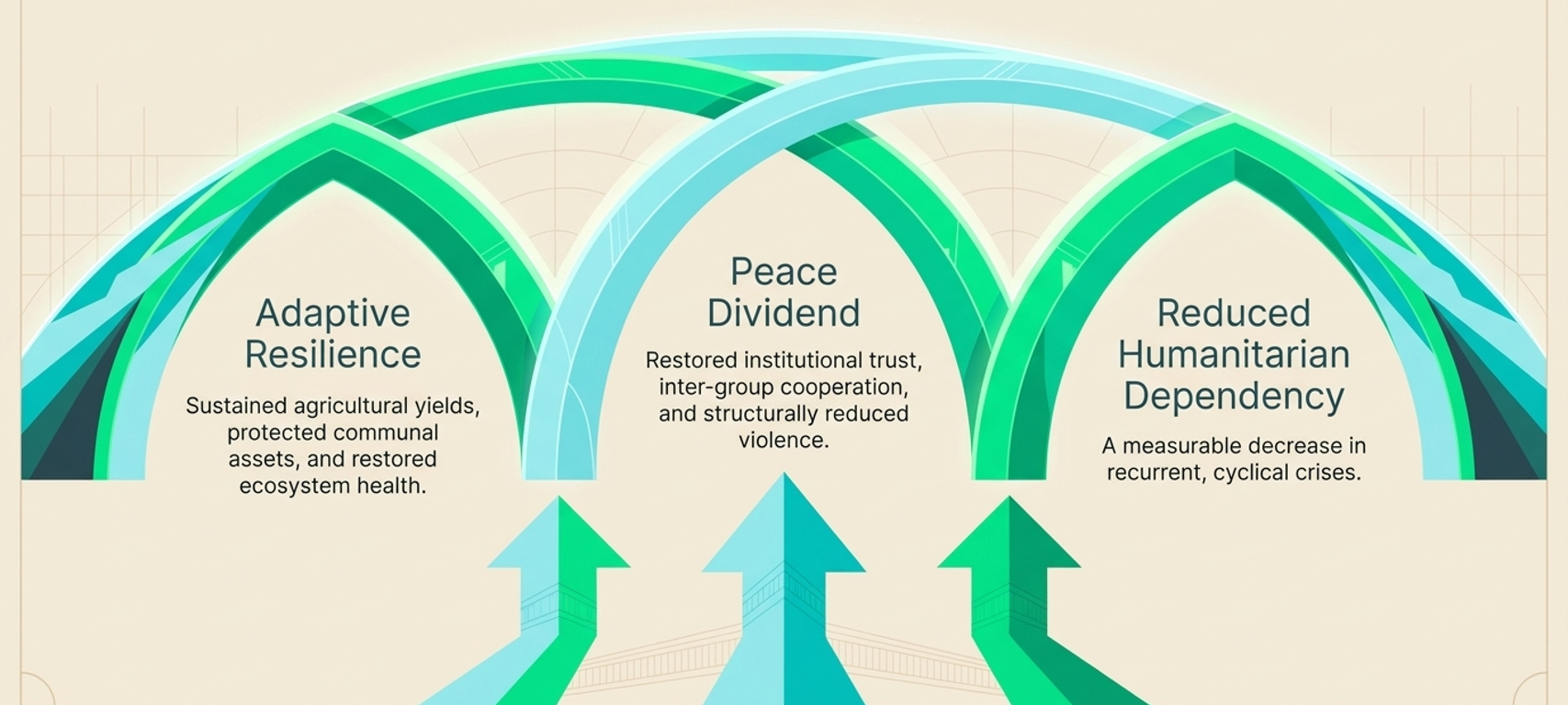
That answer has stayed with me. It captures a truth the climate finance community has been slow to accept: that in fragile places, a dollar spent on adaptation is never only a dollar spent on adaptation. It is a decision about whether the pump we install becomes a shared asset or a new flashpoint, whether the cooperative we train survives the next raid, and whether the mother walking to a training centre makes it back.
A new paper in Global Environmental Change by Luisa Fernanda Bedoya Taborda, Tiffany Morrison, and Michele Barnes (2026) names what many of us in fragile and conflict-affected states have felt for years. Climate adaptation and peacebuilding are not parallel tracks. They are on the same track. And the finance system has been paying for them as if they were separate.
The cycle our money keeps missing
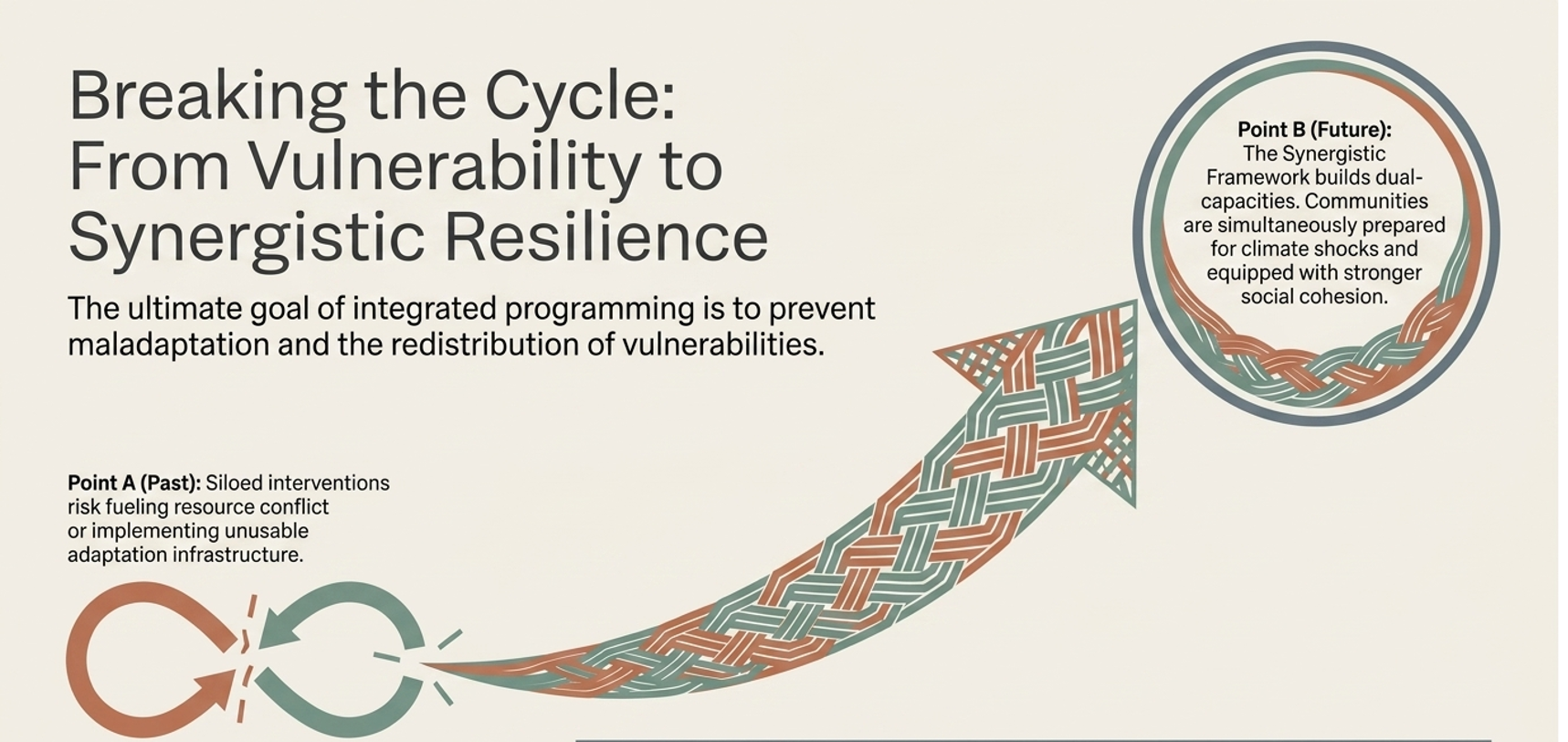
The paper’s starting point is simple, and once you see it, you cannot unsee it. Armed conflict makes communities more vulnerable to climate change. Climate change makes those same communities more vulnerable to conflict. Round and round it goes, what the authors call a reinforcing cycle of violence, vulnerability, and environmental degradation (Bedoya Taborda et al., 2026).
Conflict strips away the very things a community needs to adapt. People are displaced, so local knowledge is lost. Infrastructure is destroyed, so the physical base of resilience disappears. Armed actors control land and water, so the commons becomes a battleground. Movement is restricted, so farmers cannot reach markets and pastoralists cannot reach grazing.
Into this wound, the global finance system has too often poured climate projects that assume stability, and peace projects that assume a stable climate. Neither assumption holds. And the numbers prove it. Per-capita adaptation funding in fragile and conflict-affected states remains roughly 80 per cent lower than in stable developing countries (MacMurray, 2025; Stimson Centre, 2025). The places that need integrated finance the most receive the least of it, and what they do receive is usually fragmented.
Six places where our finance already touches both
What I find most useful about the Bedoya Taborda framework is that it does not ask donors to invent a new instrument. It asks us to notice what we are already funding, and to fund it on purpose.
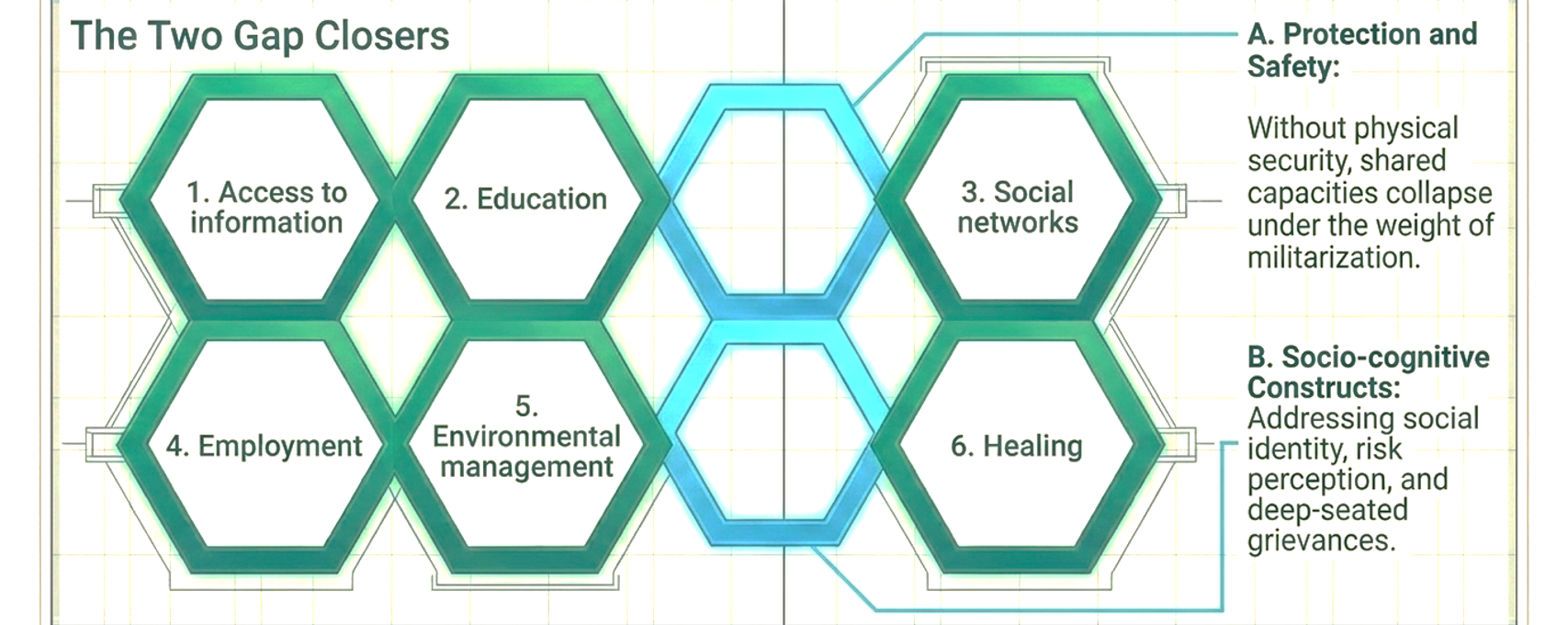
The authors identify six areas where climate adaptation and peacebuilding overlap, whether our programmes design for it or not.
Access to information matters for climate risk awareness and for transparency in peace processes. Education builds the knowledge base for environmental stewardship and for social cohesion. Social networks enable collective action for adaptation and for reconciliation. Employment reduces the incentive for violence and increases economic resilience to climate shocks. Environmental management, done together, prevents resource-based conflict and improves climate outcomes. And healing, the psychological work of recovering from trauma, is a precondition for any community to act collectively on the future.
Six overlaps. Each of them is already a line item in our concept notes. The question is whether financial decisions are made with both eyes open or only one.
Two blind spots the finance system has to close
The paper is equally honest about what is missing. Two gaps sit between the fields, and both are hidden within how we appraise and approve projects.
The first is protection and safety. Peacebuilders start here. Climate appraisal rarely mentions it. Yet an adaptation measure cannot succeed if the people implementing it are not physically secure. A woman who cannot walk to the water point, a farmer who cannot sleep in his field at harvest, a cooperative that meets under threat, these are not edge cases in fragile states. They are the median.
The second is what the authors call socio-cognitive constructs: the identities, grievances, and risk perceptions that shape how communities respond to interventions (Bedoya Taborda et al., 2026). Two villages can receive the same irrigation scheme and experience it in opposite ways, one as a shared gift, the other as a threat to historical tenure. If finance does not pay for the listening before it pays for the hardware, we will engineer conflict into the very infrastructure meant to relieve it.
What integrated finance is already showing is possible
At the Green Climate Fund, the Fragile and Conflict-Affected Situations portfolio has become, almost by necessity, a laboratory for this integrated thinking.
In Somalia, the Ugbaad programme (FP246), a seven-year, USD 95 million initiative led by FAO, is restoring 50,000 hectares of degraded rangeland and training 86,000 farmers and pastoralists, half of them women (FAO, 2024). What makes it work is not the hectares. It is the conflict-sensitive water governance committees that sit underneath them. Finance paid for both.
In Iraq, the SRVALI project (FP249), a USD 29.25 million GCF grant, is helping returnee communities rebuild climate-resilient livelihoods in areas still recovering from the war against ISIS (ReliefWeb, 2024). Land tenure, the classic driver of recurrent violence in Ninewa, is not treated as an external risk. It is a core design variable written into the budget.
Across the Mashreq, the Muscat Sub-Regional Dialogue brings together Iraq, Lebanon, Palestine, Syria, and Yemen around shared water and adaptation planning (New Security Beat, 2025). The conversation is technical on the surface and deeply political underneath, which is exactly what integrated finance is supposed to pay for.
None of these programmes is perfect. All of them are instructive about what climate finance can do when it stops pretending peace is someone else’s line item.
What the global finance architecture still has to change
Four shifts, in my view.
First, appraise every adaptation investment in a fragile context against the six overlaps and the two gaps. This is not a compliance exercise. It is a quality standard. If a project does not strengthen information, education, networks, employment, environmental management, and healing, and does not explicitly address protection and socio-cognitive dynamics, the appraisal is not complete.
Second, financial institutions and not only infrastructure. A pump without governance is a fight waiting to happen. Seeds without a cooperative are a commodity. The software of community life is where adaptation actually takes root, and where peace either grows or does not.
Third, blend climate, humanitarian, and peacebuilding finance at the programme level, not the policy level. The humanitarian-development-peace nexus is not a diplomatic slogan. It is an operating model that fragile states need funders to actually use (UN University CPR, 2024). Co-location, co-design, co-financing.
Fourth, close the adaptation finance gap in fragile states. Every year we accept an 80% per-capita shortfall is another year of cascading displacement we will later call a crisis and pay for at humanitarian prices, which are always higher than development prices.
Bedoya Taborda and her co-authors end their paper with a line I have been quoting in every meeting since I read it. “Using this framework provides an important step to building resilience and peace, thereby preventing maladaptation and the increase and/or redistribution of vulnerabilities” (Bedoya Taborda et al., 2026).
In plainer language, if the global finance system does this well, fewer women will walk two days to a training and worry only about the road home.
References
Bedoya Taborda, L. F., Morrison, T. H., & Barnes, M. L. (2026). Integrating climate adaptation and peacebuilding, capacity development in climate and conflict-affected communities. Global Environmental Change, 98, 103151. https://doi.org/10.1016/j.gloenvcha.2026.103151(opens in new window)
FAO. (2024). Ugbaad, building climate resilience of vulnerable and food-insecure communities through integrated natural resources management in Somalia. Food and Agriculture Organization of the United Nations.
IPCC. (2022). Climate change 2022, impacts, adaptation and vulnerability. Contribution of Working Group II to the Sixth Assessment Report of the Intergovernmental Panel on Climate Change (H.-O. Pörtner, D. C. Roberts, M. Tignor, E. S. Poloczanska, K. Mintenbeck, A. Alegría, M. Craig, S. Langsdorf, S. Löschke, V. Möller, A. Okem, & B. Rama, Eds.). Cambridge University Press.
MacMurray, A. (2025). The adaptation finance gap in fragile states. Stimson Center.
New Security Beat. (2025). Muscat sub-regional dialogue on climate security in the Mashreq. Wilson Center.
ReliefWeb. (2024). Supporting resilient vulnerable agricultural livelihoods in Iraq, SRVALI. United Nations Office for the Coordination of Humanitarian Affairs.
Stimson Center. (2025). Climate, peace, and security in fragile states.
UN Climate Security Mechanism. (2024). Conflict-sensitive climate action, guidance for practitioners. United Nations Department of Political and Peacebuilding Affairs, UNDP, UNEP, and DPO.
UN University Centre for Policy Research. (2024). Financing the humanitarian-development-peace nexus.
UNEP. (2024). Adapting to a changing climate in fragile contexts, avoiding maladaptation. United Nations Environment Programme.