Half of England was declared in drought this summer, the second time in two years, with seven water companies restricting some twenty-three million customers. In Hungary, groundwater in places sits metres below where it stood a decade ago, and low water on the Danube shut down all but one of the cooling-dependent turbines at the Paks nuclear plant. Across western Europe, warming has made the atmosphere thirstier, so soils now start drying in spring, even after a wet winter.
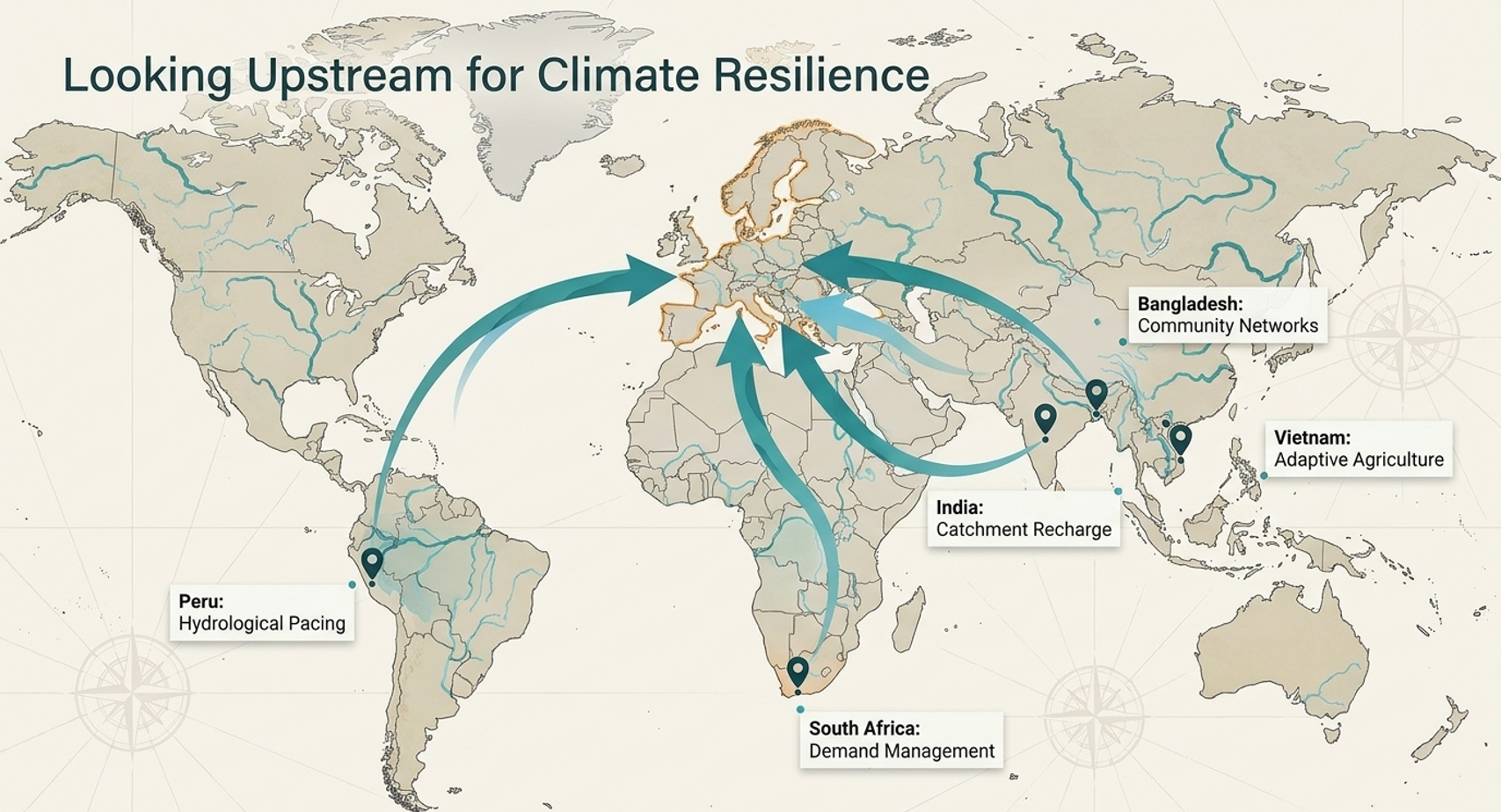
The instinct is to call this an investment failure. It is not, or not mainly. Europe has capital, engineers and superb hydrological science. What it lacks is practice. There is a difference between capacity, the resources a system can mobilise, and repertoire, the responses it has actually rehearsed. European water systems have enormous capacity and a narrow repertoire, because a century of reliable rainfall let them answer almost every problem by building more supply. Bangladesh, Rajasthan, the Peruvian Andes and the Mekong Delta have the opposite profile: less money, far more rehearsal.
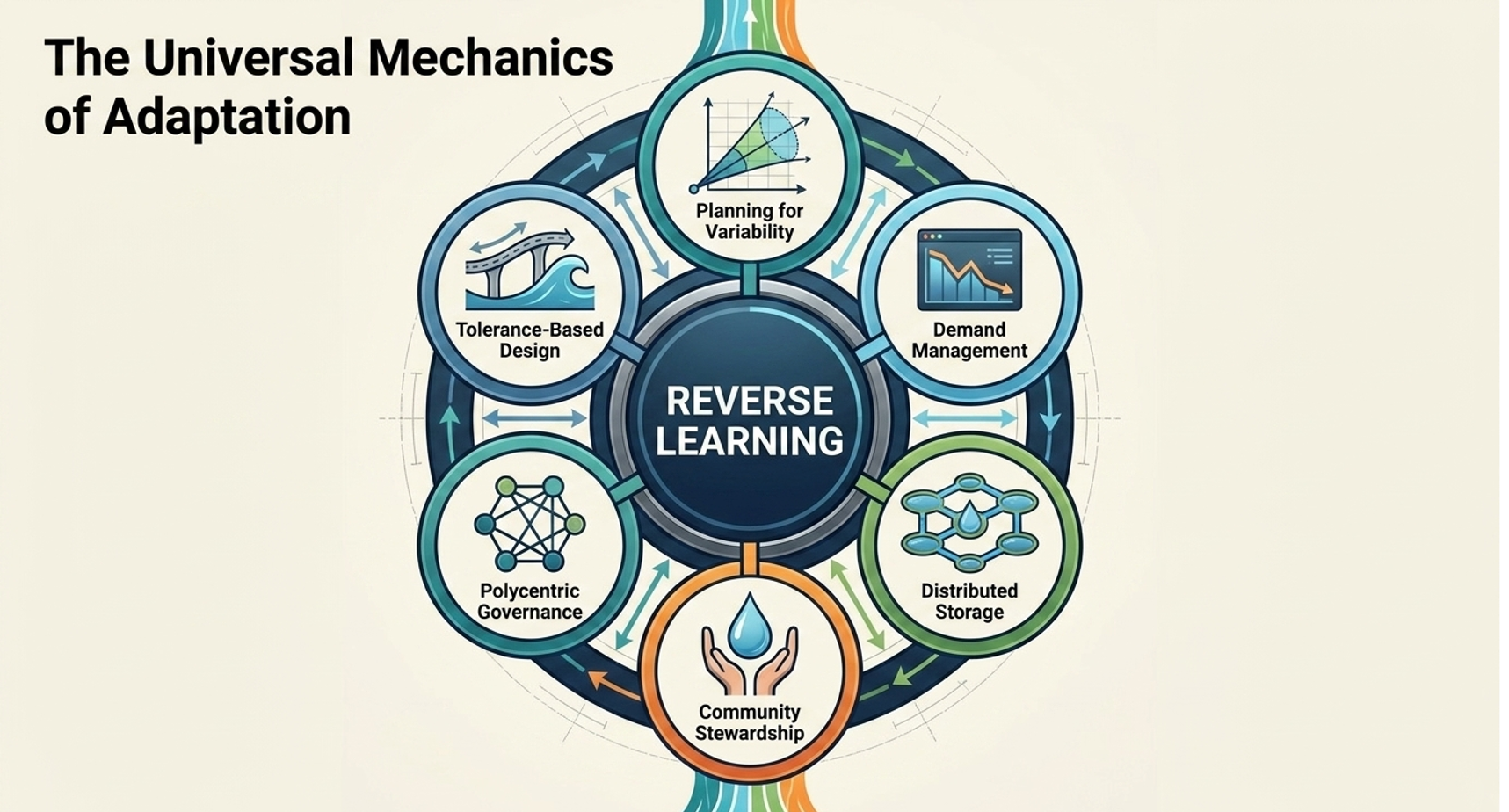
Adaptation is a repertoire problem, which is why the direction of useful learning in water has quietly reversed.
Consider early warning. European heat and drought forecasts are technically excellent, and they arrive as broadcast advisories with nobody responsible for any particular household. Bangladesh solved that problem forty years ago, not with better models but with people: its Cyclone Preparedness Programme fields tens of thousands of trained volunteers who carry the warning the last kilometre to families they know by name and get them moved. Cyclone deaths have fallen from hundreds of thousands in 1970 to hundreds today. A forecast has no value until someone is accountable for the last mile.
Consider money. Restoring Hungary’s natural water retention would cost roughly twelve billion euros, which the state cannot raise, and its own engineers note that politicians work in election cycles while water works in hundred-year horizons. Lima, a city of ten million in a desert, hit the same wall and went around it. Its regulator allowed a ring-fenced slice of household tariffs to fund the rehabilitation of pre-Incan stone canals that send wet-season flow underground to re-emerge downstream months later, and to pay the communities who maintain them. Catchment restoration became an operating cost of the utility rather than a public good queuing for budget.
Consider demand. England loses about a fifth of its treated water to leaks, roughly five times what a national hosepipe ban would save, yet the ban is what gets reached for, because it is quick and visible. Cape Town, facing a dated deadline it called Day Zero, cut city-wide consumption by close to half in two years using daily public dam-level reporting, steep block tariffs, hard pressure management and one shared target. Its residents were participants in managing a constraint, not customers being told off.
Consider the design brief itself. Viet Nam spent years keeping salt water out of the Mekong Delta with dykes and sluices before Resolution 120 reframed national policy around adapting to the delta’s new hydrology rather than resisting it, including farming systems that treat brackish water as an input. Europe still defines success as maintaining 1990: river levels adequate for existing cooling intakes, flows for existing navigation drafts, soil moisture for existing crop calendars. Changing the objective is often cheaper than defending it.
None of this is exotic. The European Water Resilience Strategy adopted last June points the same way, with its sponge landscapes designed to catch and slowly release water, its water-smart economy pillar and a proposed European Sponge Facility to gather evidence and guide member states. The agenda is right. The problem is that Europe proposes to learn it from scratch, from pilots a few years old, while systems encoding the same logic have run for decades and, in Peru’s case, for centuries.
Why does that knowledge not travel north? Partly status: expertise from poorer countries is filed as local coping, never best practice, so it never reaches the codes engineers actually work from. Partly rules: procurement and accreditation leave no compliant route to a community-maintained asset. Partly finance, since adaptation money flows south and everyone reads that as expertise flowing south too. And partly politics, because adopting a Bangladeshi or South African method can be spun as an admission of decline.
These are institutional habits, not laws of nature, and changing them needs no new science. The Sponge Facility could be built as a two-way evidence hub from day one. European regulators could examine Lima’s tariff ruling this year. Design standards could forbid calibration to a historical record that no longer describes the climate. Utilities could be required to publish consumption data daily during shortage, as Cape Town did.
Europe is not short of solutions. It is short of the experience of living inside the problem, and there is no reason to acquire that experience the slow way when others have already paid for it. The countries we have spent decades sending experts to are, in this respect, ahead of us.