Why the World Remains on the Brink & How to Bend the Trajectory
When the World Economic Forum surveyed over 1,300 experts for its Global Risks Report 2026, the verdict was grim. Half expect a turbulent or stormy world over the next two years, a 14-percentage-point surge from the previous year, and only one percent predict calm. These forecasts are damning not because the dangers are new, but because they were flagged years ago. The WEF’s 2020 risk report showed that environmental threats dominated the global landscape, while friction between major powers was accelerating. That report urged immediate collective action. Six years and a global pandemic later, the warnings remain largely unheeded. The fractures have only deepened, and our responses are still mostly reactive.
Shifting Risks
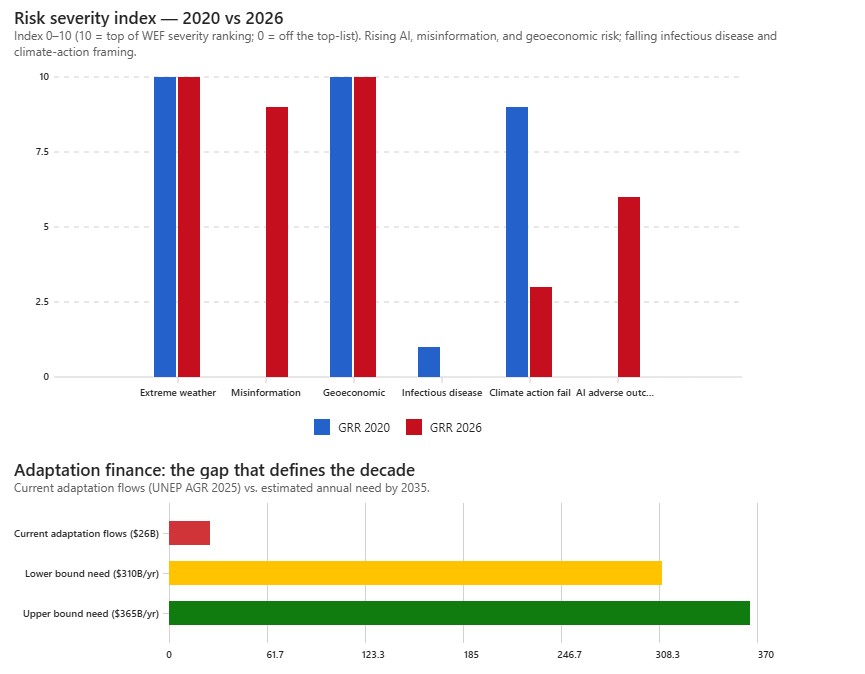
In 2020, for the first time in the survey’s history, all five top long-term risks by likelihood were environmental, from climate action failure and biodiversity loss to extreme weather and water crises. The only non-environmental threat near the top by impact was weapons of mass destruction. At the same time, “economic confrontations between major powers” was rated by respondents as the risk most likely to intensify that year, a clear harbinger of what was coming. (A brief methodological note: the 2020 edition assessed risks on separate likelihood and impact axes rather than the severity ranking adopted in later editions, but the direction of change is unmistakable.)
By 2026, that harbinger has matured into the defining threat of the era. Geoeconomic confrontation, the weaponisation of trade, sanctions, and supply chains, now ranks as the number one short-term risk, climbing eight positions year-on-year. State-based armed conflict ranks second. Environmental risks, meanwhile, have been downgraded in the near term: extreme weather fell from second to fourth, pollution from sixth to ninth, and all environmental risks declined in absolute severity score. Yet over the ten-year horizon, extreme weather, biodiversity loss, and critical change to Earth systems remain the top three, and three-quarters of respondents expect a turbulent or stormy environmental future, the most negative outlook of any category. Immediate crises are crowding out long-term perils, even as those perils quietly intensify.
Cascading Crises
We are witnessing how risks compound and cascade. A vivid example is the drought that shrank the Panama Canal in 2023: low water levels forced a cut in ship traffic, disrupting global supply chains, raising freight costs, and pushing up prices for everyday goods. One climate event set off a domino effect across trade, food security, and economic stability on multiple continents. New types of threats compound the picture. Adverse outcomes of artificial intelligence, barely on the radar in 2020, have risen from 30th place in the short-term outlook to fifth over the decade. And underlying many vulnerabilities is inequality, identified as the most interconnected risk for a second consecutive year, a force multiplier that makes societies more fragile and less able to unite against any common threat.
Why We Haven’t Learned
If the world understood these dangers, why haven’t we acted? Three structural forces explain the failure. First, political short-termism: the 2026 report documents how short-term concerns overtake shared long-term objectives, causing environmental risks to slide down the priority list even as the decade-long environmental outlook remains the most negative of any category. Second, institutional fragmentation: risk governance remains siloed, with health, finance, and environment ministries operating in separate lanes and few mechanisms linking them. Third, finance architecture misalignment: the world spends far more on disaster response and military budgets than on building resilience. The global economic costs of water insecurity alone are estimated at nearly $500 billion per year, yet investment in prevention remains a fraction of what is needed.
Bending the Trajectory: Water and Finance
If one sector embodies both the urgency and opportunity of proactive risk management, it is water. Over 2.3 billion people lack access to safe drinking water, and 3.6 billion lack access to safe sanitation. Floods and droughts alone are projected to cause $5.6 trillion in cumulative losses by 2050. In conflict-affected regions, children under five are 20 times more likely to die from diarrhoea linked to unsafe water than from war-related violence. The world faces a 40 % gap between water supply and demand by 2030. Yet it would cost about $1.7 trillion, roughly three times current investment levels, to provide safe drinking water for all, and every dollar invested yields a four-dollar return through saved medical costs and increased productivity.
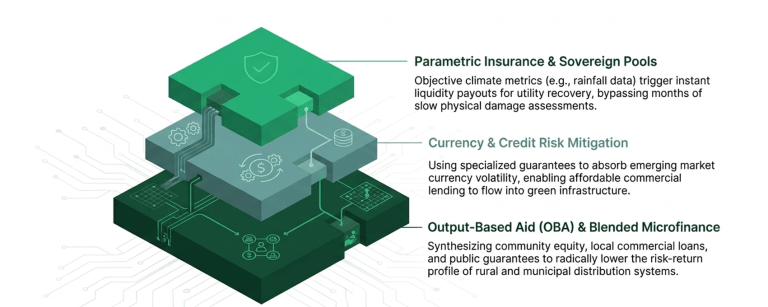
This is where the financial architecture must evolve. We need to shift from isolated projects to programmatic, blended-finance approaches that attract public, private, and community capital. Climate-resilient debt clauses, parametric insurance pools, and adaptation bonds are promising instruments, but they remain the exception rather than the norm. Community-level and digital finance, from crowdfunding platforms to mobile micro-insurance, can complement institutional flows by reaching micro-enterprises and smallholder farmers that traditional finance overlooks. These grassroots mechanisms will not replace MDB-scale investment, but they can function as fast, flexible capital for local resilience while building public constituency for broader action.
Water is a “no-regrets” but a forward entry point because strengthening water systems produces benefits across disaster risk reduction, food security, public health, energy reliability, and social stability. If the blended finance and climate finance communities seek a high-leverage demonstration that systemic risk reduction is investable, water governance and infrastructure, including nature-based solutions such as watershed restoration and wetland conservation, should be the priority.
The 2020-to-2026 trajectory shows that knowledge alone does not generate action. The world identified the risks, acquired the vocabulary of urgency, and failed to build the programmatic capacity to match. The next six years should be measured not by how many warnings are issued, but by how decisively finance is channelled toward the cascading risks that reports have documented for over a decade. Identify the risk for the seventh time, or fund the response at the cascade’s scale. That is the choice the 2026 report leaves on the table.

Sources:
World Economic Forum, Global Risks Report 2026, Press Release (14 January 2026): https://www.weforum.org/press/2026/01/global-risks-report-2026-geopolitical-and-economic-risks-rise-in-new-age-of-competition/World Economic Forum, Global Risks Report 2020 (full PDF): https://reports.weforum.org/docs/WEF_Global_Risk_Report_2020.pdfWorld Bank, Scaling Up Finance for Water: A Strategic Framework and Roadmap for Action (2023): https://www.worldbank.org/en/topic/water/publication/scaling-up-finance-for-water-a-world-bank-strategic-