The global economy rests on a set of natural systems that quietly deliver climate stability, water security, and protection from extreme risk, yet finance continues to treat them as peripheral. Mangroves, wetlands, watersheds, and degraded lands underpin trillions of dollars in economic activity, but they receive only a sliver of global climate and development capital. This is the one per cent problem in climate finance, a persistent mispricing of nature that leaves the world’s most productive and risk‑reducing assets starved of investment precisely when climate volatility makes them indispensable.
The numbers reveal the scale of the disconnect. Coastal and marine ecosystems that store blue carbon receive less than 1% of international climate finance, despite their outsized role in mitigation, adaptation, and disaster risk reduction. In parallel, the global water sector faces an annual financing gap of roughly 150 billion dollars, yet private capital contributes only about one per cent of total investment in water supply and sanitation. These figures do not reflect a lack of need or value. They reflect a failure of financial architecture.
From the perspective of the Green Climate Fund, this gap is structural rather than accidental. Nature‑based solutions deliver public goods that markets struggle to price, they generate returns over longer time horizons, and they face risks that private investors are often unwilling to bear alone. The result is chronic underinvestment, even where the economic case is strong. GCF’s work on making blended finance work for nature‑based solutions makes it clear that biodiversity, land, and water systems have enormous mitigation and resilience potential that remains largely neglected by climate finance flows.
Blue carbon ecosystems illustrate the problem clearly. Mangroves, tidal marshes, and seagrass meadows sequester carbon more efficiently than most terrestrial forests while protecting coastlines, sustaining fisheries, and reducing storm damage. From a financial standpoint, they are multi‑benefit infrastructure assets. They can underpin high‑integrity carbon credits, stabilise coastal supply chains, protect ports and cities, and reduce insured losses. Yet they are still treated as niche conservation projects rather than as investable assets. The challenge is not a lack of value, but a lack of pathways to aggregate projects, reduce risk, and crowd in capital at scale.
Nature‑based solutions should also be understood as risk-management tools, not as discretionary corporate philanthropy. In central Mexico, Volkswagen supported large‑scale reforestation and water retention works in the Puebla‑Tlaxcala region to restore hydrological processes that recharge groundwater. The project now replenishes more water each year than the company and its local supply chain consume. In India, Coca‑Cola’s aquifer recharge initiatives blend traditional water harvesting practices with modern engineering to replenish tens of millions of litres annually. These interventions are best understood as investments in operational resilience that reduce exposure to drought, water scarcity, and production disruptions.
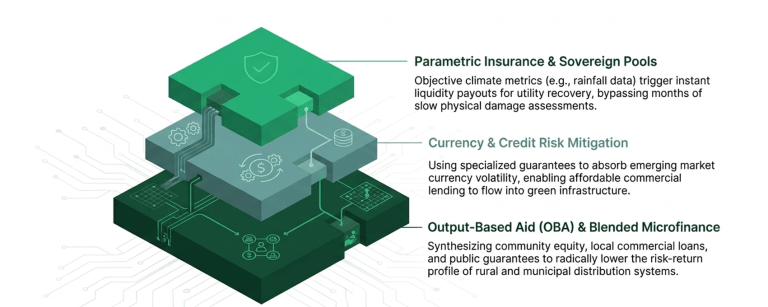
Water offers one of the clearest examples of why blended finance is essential. For decades, a rigid narrative has framed water purely as a public good incompatible with private capital. The result has been a persistent funding shortfall, leaving billions of people without safe water and sanitation. The Green Climate Fund has argued that this view is both outdated and counterproductive. Water systems are also climate assets, with mitigation potential through wetland restoration, wastewater reuse, energy efficiency, and reduced land degradation. By using concessional capital, guarantees, and risk‑sharing instruments, blended finance can make water projects bankable without compromising equity or access.
Senegal’s large‑scale desalination project demonstrates this logic in practice. By combining public guarantees, concessional finance, and a clear public‑private partnership structure, the project succeeded in mobilising substantial private investment for climate‑resilient water infrastructure powered by renewable energy. The lesson is not that desalination is a universal solution, but that well‑designed financial structures can unlock capital for essential water assets that markets would otherwise avoid.
At the other end of the spectrum, small‑scale private water enterprises are closing the last‑mile access gap. In Cambodia, government licensing, regulatory clarity, and concessional finance catalysed the emergence of hundreds of local water operators, who now serve more than a million people. This model shows that when public institutions focus on enabling conditions rather than direct delivery alone, private entrepreneurs can expand essential services faster and more efficiently.
The cost of failing to scale these approaches is already visible. Land degradation affects more than three billion people worldwide and costs the global economy around 10% of annual output in lost ecosystem services. Land‑use change and deforestation remain major sources of global emissions, making restoration not optional but necessary. Evidence consistently shows that the economic benefits of restoring land and ecosystems far exceed the costs.
For climate finance professionals, the implication is clear. The transition required is not from charity to impact, but from marginal consideration to fiduciary‑grade investment. Natural capital must be treated with the same analytical rigour as physical infrastructure or energy systems. As 2030 approaches, the stability of the global economy will depend less on how profits are allocated after the fact, and more on whether capital is directed toward the ecosystems that make those profits possible in the first place.

#BlendedFinance #SustainableFinance #PrivateCapital #RiskManagement #NatureBasedSolutions
#BlueCarbon #WaterSecurity #NaturalCapital #EcosystemRestoration #ClimateResilience #AdaptationFinance #InvestingInNature