Reimagining Water as the Catalyst for Climate-Resilient Urban Systems
In a world where climate extremes are intensifying, water is emerging as both a frontline casualty and a powerful lever for resilience. Urban systems—already strained by water scarcity, mounting waste, and rising energy demands—must now do more with less. The solution lies in the water-waste-energy nexus, a systems approach that transforms urban infrastructure from a cost centre into a climate-smart investment platform.
Water is not just a resource—it is the circulatory system of the circular economy.
From linear drainage to circular flow
Traditional municipal systems operate in silos: water is extracted, used, and discharged; waste is collected and dumped; energy is consumed without recovery. This linear model is not only inefficient but also unsustainable.
A circular economy flips this model. Waste becomes a resource. Water is reused. Energy is recovered. Nutrients are cycled back into agriculture. The result? Lower greenhouse gas emissions, improved resource productivity, and enhanced urban resilience.
Water is the thread that connects it all. Consider this:
- Globally, 80% of wastewater is discharged untreated, polluting rivers and oceans.
- In South Asia, over 50% of municipal solid waste is organic—rich in moisture and nutrients, yet often dumped in open landfills.
- Water and wastewater systems account for up to 10% of urban energy use, yet they also offer untapped potential for energy generation through biogas and heat recovery.

Financing the circular transition
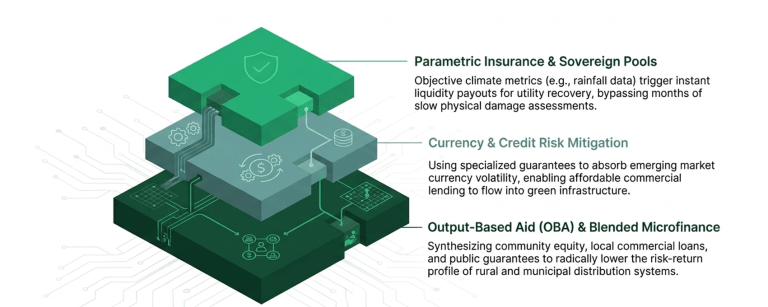
Circular systems are capital-intensive and complex. They require coordinated investments across multiple sectors—source segregation, anaerobic digestion, wastewater treatment, composting, energy recovery, and stormwater management. Each component has a different risk-return profile, demanding a tailored financing approach.
Drawing on ISO standards (e.g., ISO 14001 for environmental management, ISO 14090 for climate adaptation, ISO 37101 for sustainable communities) and World Bank guidance, a robust financial architecture emerges:
| Circular Component | Financial Instruments | Risk Mitigation Tools |
|---|---|---|
| Source Segregation | Grants (e.g., TA, GCF Readiness), microfinance (e.g., community savings groups), results-based financing (e.g., World Bank’s Program-for-Results) | Behavior change campaigns, digital tracking, community-based monitoring |
| Anaerobic Digestion & Compost | Concessional loans (e.g., ADB, EIB), equity (e.g., blended finance funds), working capital (e.g., revolving funds) | Feedstock supply guarantees, performance insurance (e.g., MIGA guarantees) |
| Wastewater Reuse | Green bonds (e.g., city-issued), PPPs (e.g., viability gap funding), blended finance (e.g., GCF + private equity) | Offtake guarantees (e.g., for reclaimed water), climate insurance |
| Energy Recovery (biogas, RDF) | Commercial loans (e.g., from local banks), equity (e.g., infrastructure funds), power purchase agreements (PPAs) | Utility payment guarantees (e.g., from DFIs), equipment performance insurance |
| Sanitary Landfills | Long-term loans (e.g., from MDBs), results-based climate finance (e.g., carbon credits via Article 6) | Environmental liability insurance, MRV-linked payments, escrow funds for O&M |
This blended finance model ensures that public funds de-risk early-stage investments, while private capital scales proven solutions.
ISO Standards: The backbone of bankability
International standards provide the credibility and structure investors seek:
- ISO 14001 ensures continuous improvement in environmental performance.
- ISO 14090 embeds climate adaptation into infrastructure design.
- ISO 37101 aligns urban systems with sustainability and resilience goals.
- ISO 14040 supports life cycle assessments to quantify circular benefits.
- ISO 59020 provides metrics to assess circularity performance across value chains.
By aligning projects with these standards, cities can demonstrate environmental integrity, operational readiness, and long-term viability, key to unlocking climate finance.
Water as the entry point for circular investment
Water is often the most visible and politically salient entry point for circular transformation. It touches every household, every business, and every ecosystem. It also offers multiple revenue streams, including treated wastewater for reuse, biogas from sludge, nutrient recovery for agriculture, and reduced costs from avoided extraction and pollution.
For example:
- In Uzbekistan, the World Bank’s Circular Economy Action Plan (CEAP) identified $860 million in circular agri-food investments, including drip irrigation, wastewater reuse, and biogas from manure, with a projected 100% return on investment and a 34% reduction in GHG emissions.
- In Almaty, Kazakhstan, circular construction and industrial projects are expected to generate $1.3 billion in benefits from $289 million in investments. A $21 million bottom ash processing plant is already under development to convert thermal power plant waste into construction materials and heat.
These examples show that circular water systems are financially attractive.
The way forward
To scale these models, cities and countries must:
- Integrate circularity into urban and sectoral strategies, with water as a central pillar.
- Establish enabling policies (e.g., EPR, landfill taxes, green procurement, water reuse standards).
- Build capacity for ISO-aligned project design, MRV, and climate risk screening.
- Create investment pipelines using blended-finance structures tailored to each component.
- Foster public-private partnerships with clear risk-sharing frameworks and long-term offtake agreements.
The circular economy is a financial opportunity. By embracing water as the connective tissue of the circular transition and aligning with global standards, cities can attract the capital needed to build resilient, low-carbon futures.