Climate change is intensifying floods, droughts, and water scarcity. However, global financing for water security and climate resilience falls far short of what’s needed. A 2024 survey of 59 Ministries of Finance (MoFs) finds that while finance leaders recognise water-related climate risks, few have fully integrated these risks into economic planning or mobilised adequate investment. Bridging this gap requires mainstreaming water in fiscal policy, scaling up climate finance (public and private), and innovating with insurance and risk management to protect lives and economies.
Finance ministries are beginning to embed water-related climate risks into macroeconomic policy, budgets, and public investment decisions, in line with the Coalition’s Helsinki Principle 4. In practice, this means using analytical tools (climate–economy models, stress-test scenarios) to assess how floods or droughts could impact GDP, revenue, and debt. Only 26% of MoFs have quantified adaptation and resilience investment needs so far, and most have yet to integrate climate factors fully into core models. To bridge this gap, MoFs are adopting climate-responsive budgeting (tagging and prioritising resilience spending) and updating project appraisal guidelines to account for future hydrological extremes. For example, new public works are being screened for flood/drought risks before funding. These technical steps help ensure economic plans and infrastructure investments are robust against climate uncertainties.
To guard against the financial shocks of floods and droughts, governments are implementing innovations in disaster risk finance and insurance. Many countries have joined sovereign risk pools and purchased parametric insurance that pays out automatically when rainfall or river levels breach thresholds, delivering quick funds for disaster response. For instance, Caribbean and African risk pools use such parametric covers to help member governments manage hurricane and drought costs. Additionally, catastrophe bonds are being issued to transfer extreme flood risk to capital markets, tapping global investors for contingent financing. The insurance industry is also partnering with the public sector on risk reduction; it is supporting nature-based solutions – e.g., underwriting coastal mangrove restoration because it can halve storm-surge losses. Technical tools like IoT sensors and climate data platforms inform these schemes, improving risk modelling and pricing. The upshot is a more robust safety net: when water disasters strike, pre-arranged insurance and finance mechanisms kick in, reducing budget shocks and enabling faster recovery. Crucially, these approaches create incentives for preventive action (lower premiums for better flood defences, etc.), aligning financial and climate resilience objectives.
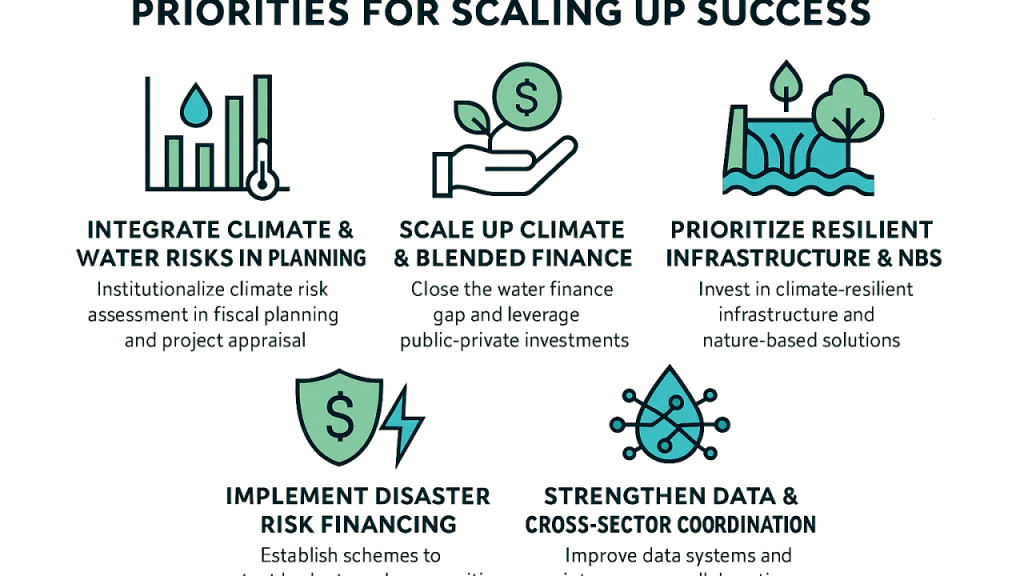
To scale up these successes, senior decision-makers should focus on the following priorities:
- Integrate Climate & Water Risks in Planning: Institutionalize climate risk assessment in all fiscal planning, budgeting, and project appraisal processes. This includes climate budget tagging, scenario analysis for major investments, and requiring that ministries quantify adaptation needs as part of economic strategy.
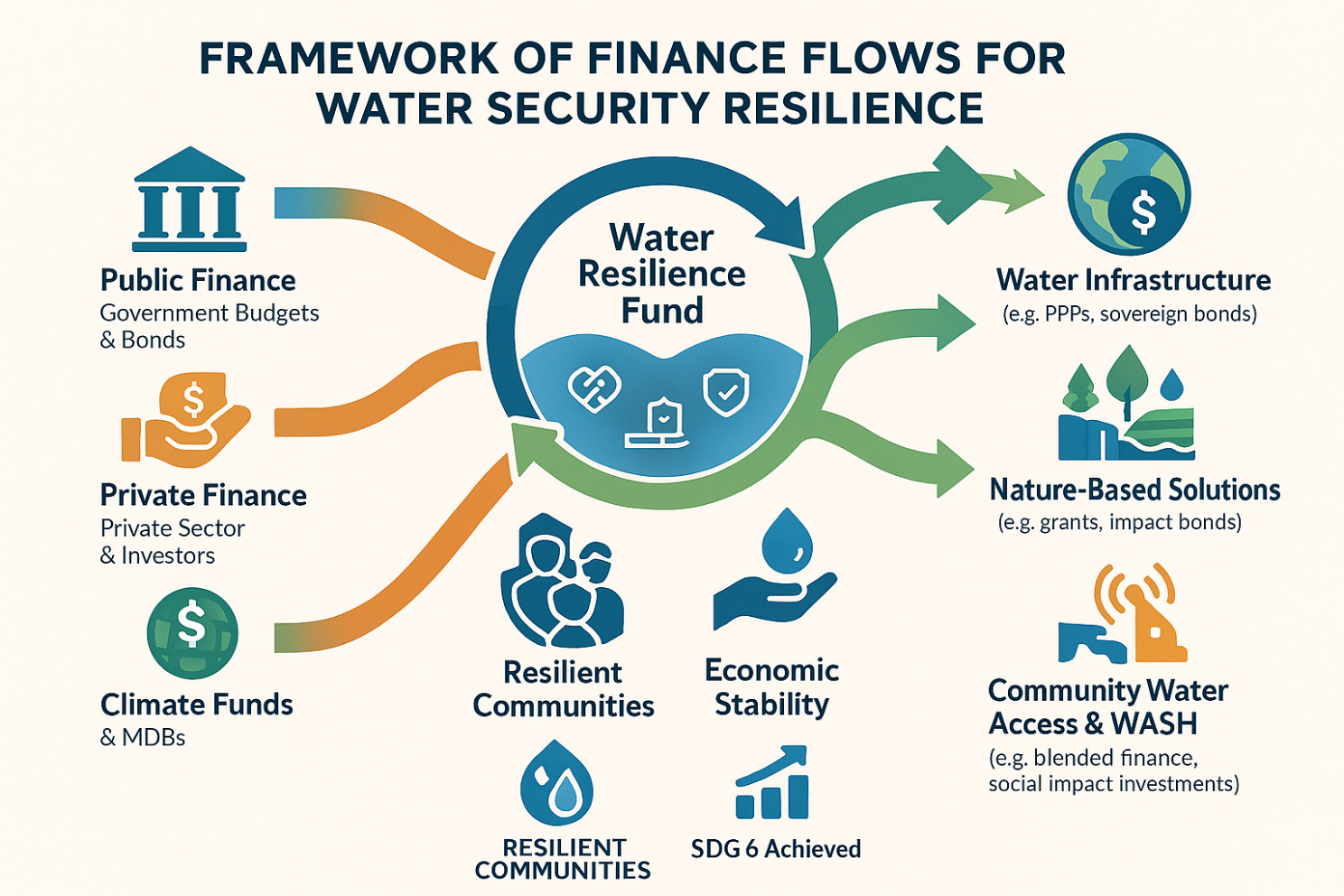
- Scale Up Climate & Blended Finance: Close the water finance gap by expanding access to climate funds and leveraging blended public-private investment models. Use public or concessional funds as catalytic capital to attract private investors (e.g. through green bonds, PPPs, or guarantees), and actively pursue innovative deals like debt-for-resilience swaps.
- Implement Disaster Risk Financing: Establish comprehensive disaster risk finance schemes to protect budgets and communities. This should include contingent financing instruments (reserve funds, credit lines), parametric insurance for extreme events, and participation in regional risk pools or catastrophe bond programs to transfer peak risks.
- Prioritize Resilient Infrastructure & NbS: Invest in climate-resilient water infrastructure and nature-based solutions as dual benefits for adaptation. Ensure new projects are built to withstand future conditions, and fund ecosystem-based approaches (like watershed restoration, mangrove conservation) that reduce risks. Coupling these investments with strong early warning systems will maximize their effectiveness.
- Strengthen Data & Cross-Sector Coordination: Improve data systems and inter-agency coordination for water-climate action. Finance ministries should lead in developing high-quality data on water risks and in convening water, environment, and planning agencies to align policies. Better information (e.g. risk maps, climate impact projections) and collaboration will enable evidence-based decisions and more efficient use of funds.
#WaterSecurity #ClimateFinance #ClimateResilience #AdaptationFinance #DisasterRiskFinance #BlendedFinance #NatureBasedSolutions #FiscalPolicy #MoFs #ResilientInfrastructure #EarlyWarningSystems #ClimateRisk #WaterAndClimate

 Bapon (SHM) Fakhruddin, PhD