The seasonal rhythms of Earth’s glaciers with summer surges and winter calms are speaking to us. They are telling us the story of climate change in real time, in cycles that we can observe every year. They show us where we still have time to act (Antarctica’s ice, for instance, has not yet awakened to melting, a window of opportunity to keep it stable) and where the situation is urgent (the Alps, the Andes, and so many mountain ranges where glaciers are in steep decline). The evidence is that glaciers are dynamic, but their recent dynamism is a distress signal. Let 2025 be remembered as the year we heeded that signal when humanity finally woke up to the rapid changes in the cryosphere and united to take bold steps in response.
United Nations Secretary-General António Guterres has bluntly stated that “losing these giants would be a giant problem for our world.” Glaciers hold about 70% of the world’s freshwater and sustain ecosystems and economies alike. If we allow them to disappear, the consequences from sea-level rise inundating low-lying nations to the collapse of freshwater supplies in semi-arid regions could be catastrophic. “The preservation of glaciers is not only an environmental issue or an economic issue, but it is also a matter of survival,” said World Meteorological Organization’s SG Celeste Saulo, underscoring the stakes.
The Green Climate Fund co-designed the $3.5 billion Glaciers to Farms (#G2F) program https://lnkd.in/gUTmugdc to transform glacier meltwater from a climate threat into a source of resilience by supporting climate-smart agriculture, water infrastructure, and early warning systems for over 13 million people.
Now is the time to act to preserve the seasonal heartbeat of the world’s glaciers for future generations, and with it, the well-being of our planet as a whole. Together, we can and must ensure that the cryosphere’s warning is met with humanity’s resolve.
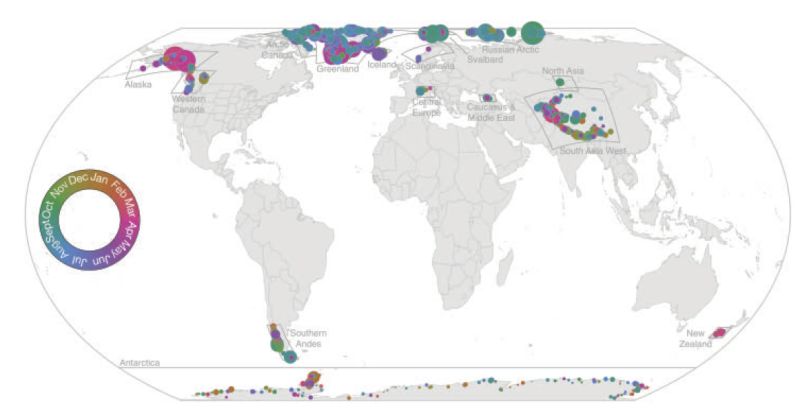
Figure source- AAAS Science (this map shows how glacier movement speeds change with seasons across 3,287 glaciers worldwide.
Colour = When glaciers move fastest during the year
Circle size = How much the speed changes between seasons
Main patterns:
Arctic glaciers show significant seasonal speed changes (big circles)
Antarctic glaciers show slight seasonal variation (small circles)
Northern and Southern Hemisphere glaciers reach peak speeds about 6 months apart (opposite seasons)
#GlacierDynamics, #CryosphereScience, #SeasonalGlacierFlow, #GlacierVelocity, #MeltwaterMechanics #BasalHydrology #ClimateSignals
#GlacierMonitoring #EarthObservation #GlacierData #ScienceForPolicy
#ClimateEmergency #WaterSecurity #SeaLevelRise #AdaptationNow
#GlacierLoss #Glaciers2025 #WorldGlacierDay #InternationalYearOfGlaciers
#VoiceOfGlaciers #CryosphereJustice #Climbing4SDGs #ProtectOurIce

 Bapon (SHM) Fakhruddin, PhD