GAIA (Geographic Ancestor Inference Algorithm), has illuminated the paths our ancestors took as they migrated across continents, shaping the genetic diversity we see today. The roots of humanity are deeply embedded in Africa. By 1 million years ago, approximately 95% of the genetic ancestry of modern humans can be traced to ancestors who lived in Africa. The research highlights the interconnectedness of our shared history, as small but significant migrations out of Africa—particularly through the Middle East—laid the foundation for the genetic diversity we see across the globe today.
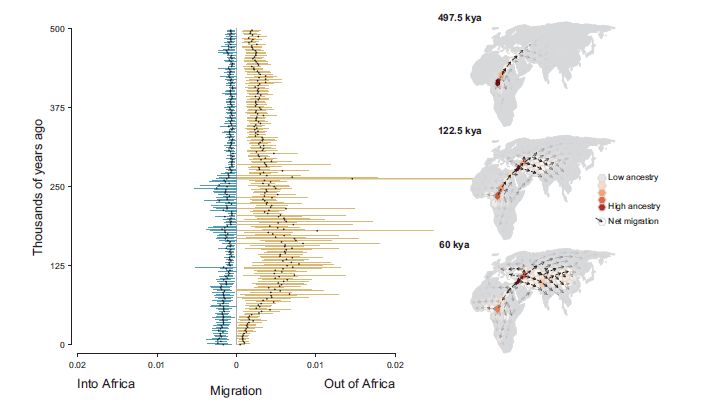
This research introduced the concept of ancestry flux, which allows us to quantify the movement of genetic ancestry over time. It shows us that the greatest migrations out of Africa occurred between 100,000 and 150,000 years ago, primarily through the northern route across the Sinai Peninsula. These migrations are linked to movements of ideas, cultures, and innovations that shaped the world as we know it.
But this research also cautions us that our family histories aren’t as simple as we might think. We can’t put neat labels on human ancestry because it’s always changing as we look further back in time. In a world often fractured by conflict and inequality, this knowledge reminds us that we are all part of the same human family, with a shared past and a shared responsibility to build a better future.
#empathy, #climatechange #poverty #inequality #injustice. #GeneticDiversity #HumanAncestry #MigrationHistory #SharedHumanity #Anthropology #Empathy #ClimateChange #Poverty #Inequality #Injustice #GlobalHistory
Figure- The inferred flux in spatiotemporal ancestry coefficients has been tracked through time. Each data point represents a mean estimate (calculated from random subsets of data and bounded by standard deviation) showing how much historical migration occurred between shared genetic ancestors of modern-day samples moving into or out of Africa over time.
Tracing Humanity’s Shared Journey Through Genetic Ancestry

 Bapon (SHM) Fakhruddin, PhD