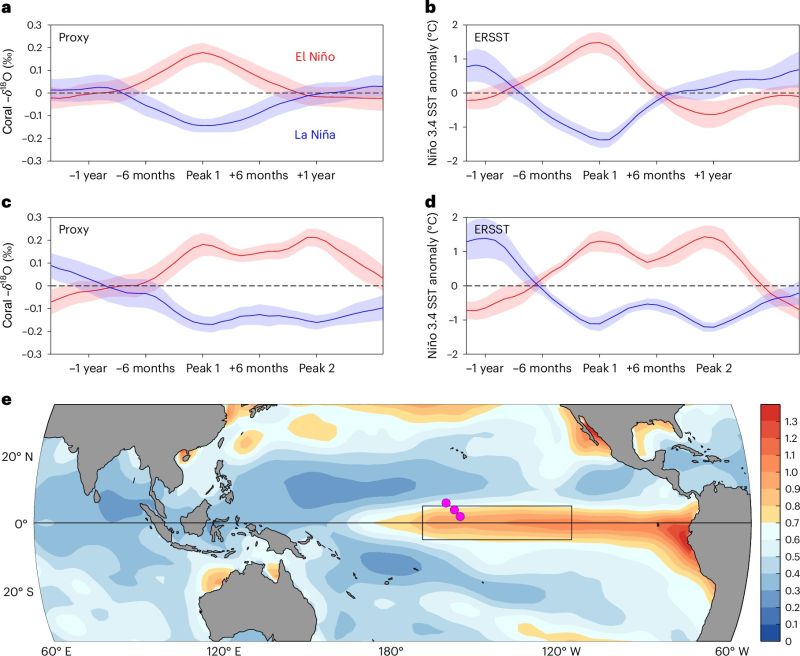
A study published in Nature Geoscience has revealed that multi-year El Niño events have become five times more frequent over the past 7,000 years. By analyzing fossil coral data and using advanced climate models, researchers discovered that these events, which now last for two or more years, have evolved from occurring every 3.5 years to roughly every 4.1 years. This significant change has been attributed to orbital forcing, which has altered how solar radiation is distributed, ultimately affecting the tropical Pacific’s ocean structure.
What does it means to us!?
When El Niño events persist for multiple years, they can trigger prolonged droughts, flooding, and temperature anomalies that severely impact communities worldwide. From South America to Indonesia, these extended weather disruptions threaten food security, damage infrastructure, and affect millions of lives. What’s more worrying is that climate models suggest this trend will likely intensify in the coming decades due to human-induced climate change, creating even more frequent and severe multi-year events that could pose unprecedented challenges to global communities and ecosystems.
2025 is a critical year for the #Ocean! The oceans are speaking to us through the rhythm of ENSO events—a warning that prolonged imbalances are cascading through planetary systems. Let us rise to the challenge, ensuring that neither nature nor humanity is left adrift.
Full paper here https://lnkd.in/gBQBNYcg
Figure: a–d, The temporal evolution of single-year (a and b) and multi-year (c and d) ENSO cases (red lines, El Niño; blue lines, La Niña), showing composites of selected proxy reconstruction of the coral oxygen isotope anomaly (a and c) and the Niño 3.4 SST anomaly (b and d). The solid lines and the shading show the mean and 1 s.d. of all cases in the corresponding composites. e, The locations of the fossil coral synthesis used in this study (magenta circles). The ERSST monthly SSTA variability (s.d.) during 1854–2023 ce is represented by the shaded colours. The black box is for the Niño 3.4 region.
#ElNino #ClimateChange #ENSO #OceanScience #ExtremeWeather #FoodSecurity #DisasterRisk #GlobalClimate #ClimateAction #MarineSystems #Droughts #Floods #TemperatureAnomalies #SustainableFuture #ClimateResilience

 Bapon (SHM) Fakhruddin, PhD