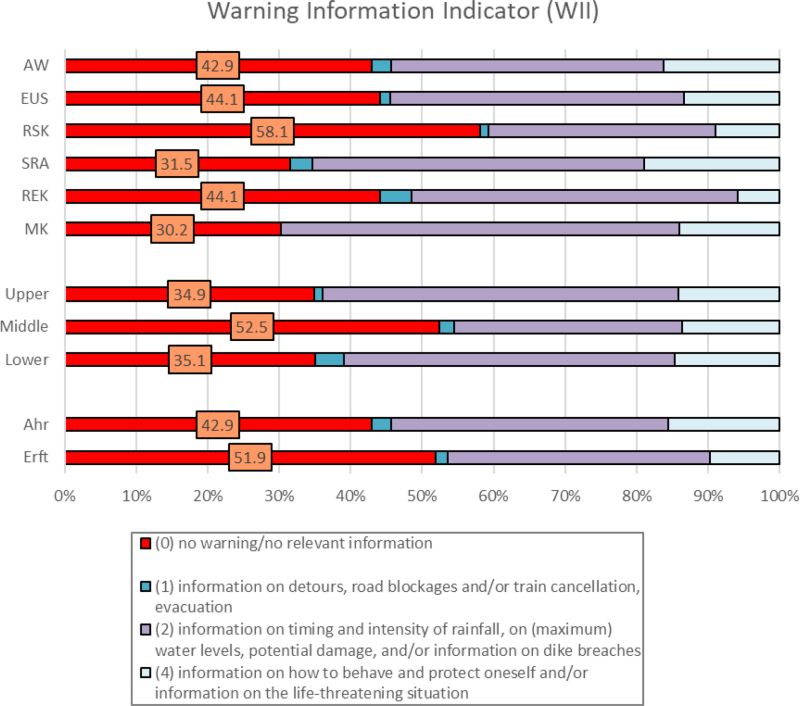
A nice article by Anna Heidenreich, Heather J. Murdock, and Annegret H. Thieken, supported by Germany’s Federal Ministry of Education and Research, sets out to assess how warning performance varies both between administrative districts and across watershed segments. This investigation was instigated by the tragic losses during the 2021 flood event, which, despite the existence of national warning systems, resulted in nearly 190 fatalities in Germany. Such results signify the vital need for robust early warning frameworks that can adapt to rapid, flash flood events occurring in regions with complex geographic and administrative dynamics.
Germany’s flood management involves multiple tiers of government like other developing countries. The German Weather Service is responsible for monitoring rainfall, while federal state agencies manage river flood warnings. Dissemination of these warnings to the public falls to regional governments and local entities.
The study found that warning performance varied significantly between administrative districts—with some, like Ahrweiler, experiencing more severe impacts despite receiving warnings—illustrating disparities in the effectiveness of local warning systems. While watershed location influenced the timing—upper watershed areas tended to receive earlier warnings—middle segments often received warnings later or not at all, suggesting that the natural delay provided by watershed position was less beneficial in rapid onset situations. Overall, the severity of the flood event often outweighed the benefits of early warning, and the quality and clarity of warning information were closely linked to public situational awareness and adaptive response.
As climate change augments the frequency and intensity of such natural hazards, the refinement of our early warning systems is not just a technical challenge, but a moral imperative. The insights gleaned from the 2021 flood in Germany provide lessons learned for rethinking and redesigning flood warning strategies. They remind us that effective flood risk management must be context-specific—attuned to both administrative and natural watershed dynamics—and underpinned by clear, credible communication.
Full paper here https://lnkd.in/gSjpP4Te
#FloodRisk #EarlyWarningSystems #ClimateAdaptation #DisasterManagement #FloodResilience #ClimateChange #PublicSafety #WatershedManagement #CommunityPreparedness #RiskReduction

 Bapon (SHM) Fakhruddin, PhD