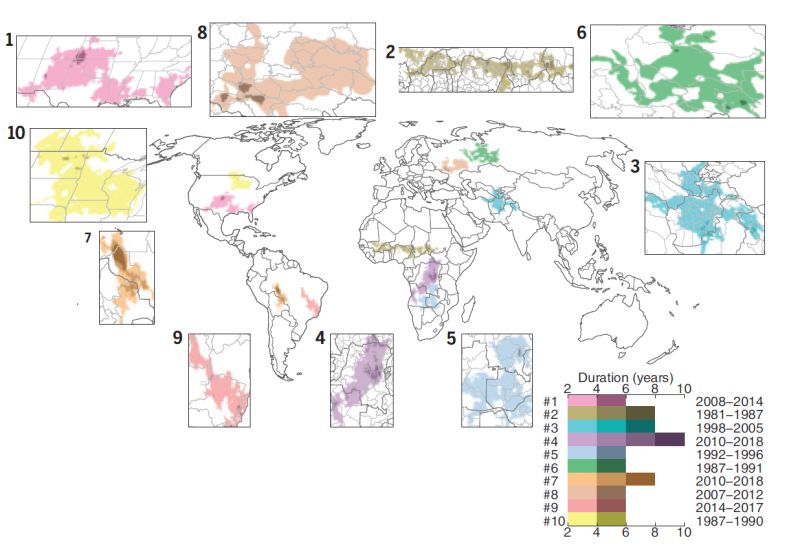
Over the 38-year period from 1980 to 2018, researchers identified 13,176 distinct multiyear droughts (MYD) events across the globe. The top 10 most severe droughts are extraordinary in their scale, duration, and impact. These events occurred across continents, sparing none except Australia. They were ranked based on their affected area, duration, and the severity of climatic anomalies, as measured by the SPEI.
The spatiotemporal distribution of these MYDs reveals a troubling trend: they are becoming more widespread, hotter, and drier. The global land area affected by MYDs has increased at an alarming rate of approximately 49,279 sqm per year. The impacts of MYDs are as diverse as they are devastating. They include:
Drinking Water Shortages: Communities in affected regions face severe water scarcity, threatening public health and sanitation.
Crop Failures: Prolonged droughts disrupt agricultural systems, leading to food insecurity and economic instability.
Tree Mortality and Wildfires: Forest ecosystems suffer from increased tree mortality, which, in turn, exacerbates the risk of wildfires.
Reduced Ecosystem Productivity: The prolonged stress on vegetation diminishes the productivity of ecosystems, affecting biodiversity and carbon sequestration.
These impacts are not linear; they amplify over time. For instance, grassland productivity can decline threefold in the second year of a drought compared to the first. Prolonged water stress exceeds the physiological thresholds of plants, leading to widespread vegetation dieback and even mortality. The loss of key plant species has cascading effects on the composition, structure, and function of ecosystems, with long-term consequences for biodiversity and human livelihoods.
The increasing frequency and severity of MYDs are closely linked to shifts in the hydrological cycle driven by climate change. Rising temperatures and changing precipitation patterns are amplifying the intensity and duration of droughts. The data show that temperature anomalies in MYD-affected areas have risen significantly, and precipitation deficits have become more pronounced.
Understanding the mechanisms driving ecological responses to MYDs is crucial for developing effective mitigation and adaptation strategies. Recent advances in remote sensing technologies, such as the use of kernel Normalized Difference Vegetation Index (kNDVI) and satellite-based solar-induced chlorophyll fluorescence, offer promising tools for monitoring vegetation dynamics during droughts. These technologies can provide more accurate and comprehensive insights into the impacts of MYDs on ecosystem productivity and resilience.
#multiyearDroughts; #climateCrisis #droughtImpacts #globalDroughts
#climateAction #waterScarcity #ecosystemResilience #sustainableFuture
#climateAdaptation #droughtAwareness #climateChange #saveOurPlanet
#droughtMitigation #globalWarming #environmentalCrisis
Bapon (SHM) Fakhruddin, PhD
Water and Climate Leader| Strategic Investment Partnerships and Co-Investments| Professor| EW4ALL| Board Member| Chair- CODATA TG| Award Winner (SDG 2021, EWS 2025)
Global Multiyear Droughts Intensify with Severe Ecological and Human Impacts

 Bapon (SHM) Fakhruddin, PhD