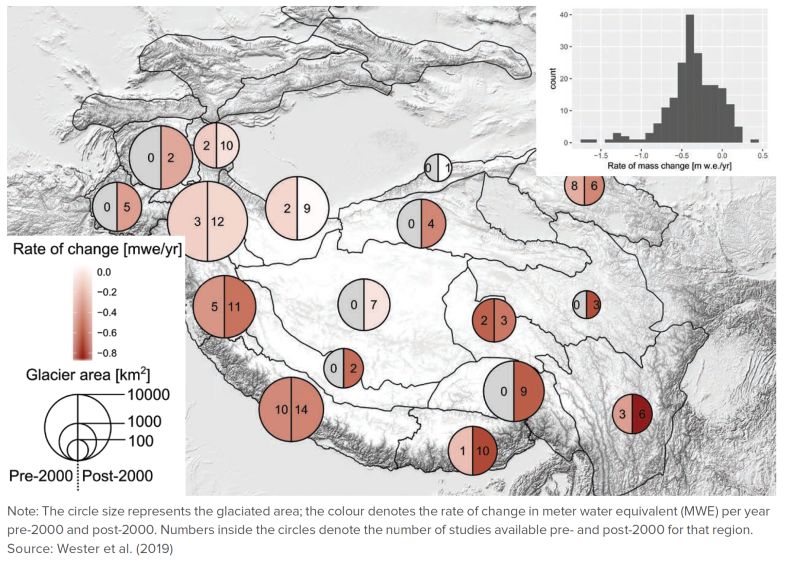
It’s been a pleasure to come to Bhutan and talk about the rapid melting of glaciers in the Third Pole region. This area, containing Earth’s third-largest storage of frozen water after Antarctica and the Arctic, is experiencing unprecedented changes that threaten the lives and livelihoods of billions.
– The Third Pole’s glaciers cover approximately 100,000 square km, containing between 3,000-4,700 cubic km of ice
– These glaciers feed 10 major river systems, including the Ganges, Indus, Mekong, Yangtze, and Yellow rivers
– Over 240 million people live in the Himalayan region, with 1.7 billion in downstream river basins
– Food grown in these river basins reaches approximately 3 billion people globally
According to the Hindu Kush Himalaya Assessment, even if we limit global temperature rise to 1.5°C above pre-industrial levels, these glaciers will lose one-third of their volume by 2100. Under current emission trends, the loss could reach two-thirds.
The region is warming at triple the global average rate – 0.3°C per decade. This accelerated warming, combined with black carbon pollution from the Indo-Gangetic Plains, creates a perfect storm for glacial melt. Consequences could be huge–
1. Water security: Diminishing glaciers threaten agriculture, drinking water, and hydroelectric production
2. Natural hazards: We’re seeing increased risks of glacial lake outburst floods (GLOFs), with 4,260 to 8,200 glacial lakes currently in the Hindu Kush Himalaya region
3. Biodiversity loss: Unique high-altitude ecosystems are under threat
4. Economic impact: Tourism, agriculture, and hydropower sectors face severe disruption
The Third Pole preservation is essential for humanity’s future.
#ThirdPole #HimalayanGlaciers #ClimateChange #WaterSecurity #GlacierMelt #Cryosphere #ClimateAdaptation #MountainEcosystems #GLOFs #DisasterRiskReduction #ClimateAction #SustainableDevelopment

 Bapon (SHM) Fakhruddin, PhD