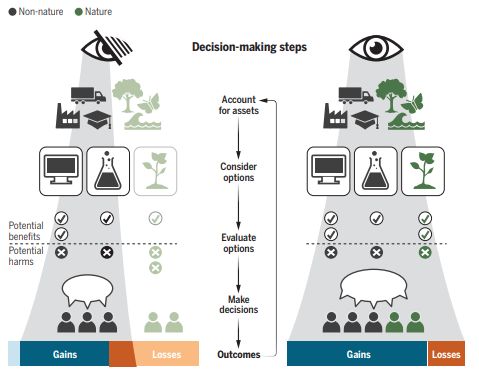
For too long, we have applied a narrow lens to our policy decisions, often overlooking nature’s vital role in our economies, societies, and very survival. This approach has led to unintended costs, missed opportunities, and an inaccurate representation of our true national wealth.
As a paradigm shift, we must embed the consideration of nature throughout our policy processes, from economic planning to national security strategies and all sector development initiatives.
Why is this so crucial? Our sectors, national security, and economies all depend on nature. Yet, we continue to develop policies in these spheres independently, rarely considering nature’s roles. This siloed approach is no longer sustainable or sensible in our interconnected world.
Mainstreaming nature-based solutions or echo-system adaptation in our decision-making has the potential to create greater gains across economic, social, and environmental outcomes. It will provide us with a more accurate picture of our choices’ true costs and benefits, allowing for more informed and sustainable decisions.
To achieve this, we need to adopt what we call the “CASE” approach:
Cross-sectoral: We must craft policies that make relevant and aligned changes across multiple sectors rather than addressing them one at a time.
Appropriate: Nature should be considered at all appropriate points in the decision-making process, even in sectors where it has not been historically accounted for.
Strategic: We must focus on decisions that influence impactful pathways, ensuring that our mainstreaming efforts achieve the pace of change needed to improve wellbeing and reverse nature loss.
Evidence-based: Our efforts must be grounded in robust scientific evidence, drawing on multiple sources of knowledge and understanding.
Implementing this approach will require changes in how we account for our assets, consider our options, evaluate those options, and ultimately make decisions. It will mean including natural capital in our national accounts, considering nature-based solutions alongside traditional approaches, and ensuring that our cost-benefit analyses fully account for environmental impacts and ecosystem services.
This is not an easy task. It will require investment in new capacities, the development of new methodologies, and a willingness to challenge long-held assumptions. But the potential benefits are immense.
As leaders, we are responsible for ensuring that our governance systems evolve to meet these challenges. By mainstreaming nature in our decision-making processes, we can create a more sustainable, resilient, and prosperous future for all.
#naturemainstreaming, #natureinpolicy, #naturebased, #ecosystemservices, #naturalcapital, #sustainabledecisions, #holisticpolicy, #naturepositive, #biodiversityeconomy, #greenaccounting, #natureinclusive, #ecosystemvalue, #naturefirst, #integratedpolicy, #naturesmartdecisions, Green Climate Fund

 Bapon (SHM) Fakhruddin, PhD