The climate crisis demands an urgent and sweeping transformation of our energy systems. As we rapidly scale up wind and solar to decarbonize electricity generation, the intermittency of these renewable sources poses a significant challenge.
This is where pumped storage hydropower offers a proven, cost-effective solution for grid balancing and long-duration energy storage.
Around the world, over 300 pumped storage plants are already in operation, with a total capacity of over 160 GW. These facilities can store vast amounts of energy by pumping water uphill into a reservoir when the power supply exceeds demand and releasing it to generate electricity on demand.
The benefits are substantial:
# Pumped storage allows better integration of renewables, avoiding curtailment of wind and solar when supply overwhelms the grid. Studies show it can enable twice as much renewable capacity.
# It provides storage across days or even weeks to handle sustained lulls in renewable generation – unlike lithium batteries that offer only short-duration storage.
# Pumped storage is the most affordable large-scale energy storage available, at around $100-200 per kWh. This is vital for viability.
# It delivers ancillary grid services that stabilize frequency and voltage, maintaining reliability.
The technology is time-tested, and new sites are shovel-ready – over 14,000 potential pumped storage locations have been identified just in the US.
Yet only a few new capacities have been built in decades. Complex licensing and uncertainty over returns on investment are holding back projects.
The Inflation Reduction Act has made pumped storage eligible for clean energy tax credits, finally providing incentives. But more policy support is imperative.
Only an orchestrated effort across the climate financing landscape can provide the affordable capital needed to build out pumped storage rapidly and dependably. The technology is proven – it is up to us to prove its economic viability. We as a climate financer like –Green Climate Fund and CIF, could provide concessional financing to prioritize these projects.
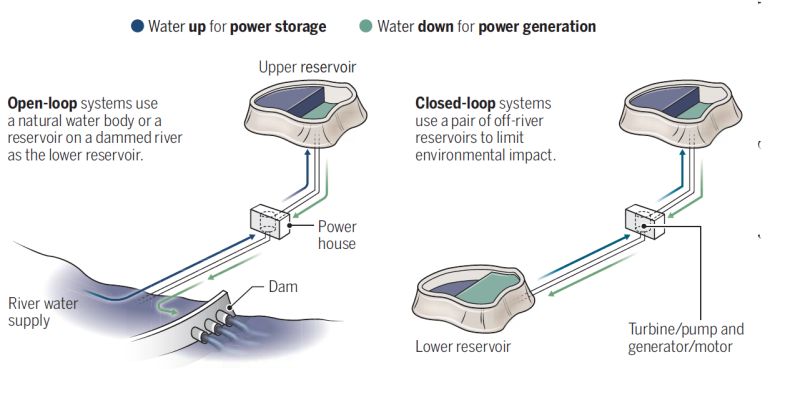
Electricity can be stored to pump water from a low-lying reservoir into a higher one. When power is needed, the water flows back down and spins a turbine—often the pump, spinning in reverse. The flow rate and the elevation difference determine the power output, and the volume of the upper reservoir determines how much energy is stored—and thus how long the water battery lasts.
Bapon (SHM) Fakhruddin, PhD
Water and Climate Leader| Strategic Investment Partnerships and Co-Investments| Professor| EW4ALL| Board Member| Chair- CODATA TG| Award Winner (SDG 2021, EWS 2025)
Unlocking Large-Scale Energy Storage to Accelerate the Renewable Transition through Pumped Storage Hydropower

 Bapon (SHM) Fakhruddin, PhD