We stand at a pivotal moment in our fight against #ClimateChange. As we address #GHGemissions, a critical question emerges – what is the true cost of meaningful #ClimateAction?
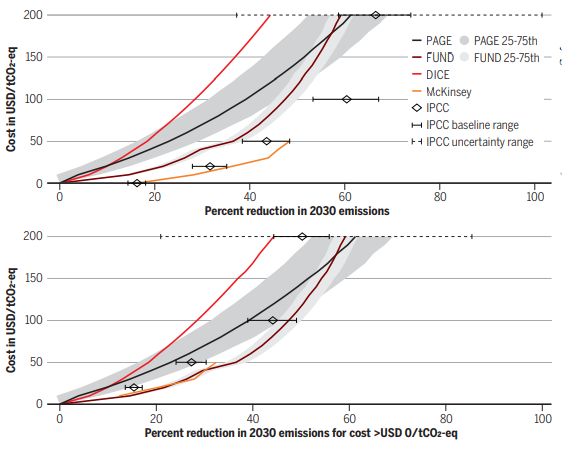
The #IPCC and leading #IAMs show striking differences. The IPCC suggests substantial reductions are possible at low/negative costs. But economic models indicate higher overall costs.
This discrepancy has profound implications for #ClimatePolicy, public perception and international cooperation. The allure of “costless” mitigation is attractive, but likely understates complexities of transitioning economies.
As we work to reconcile methodologies, we must acknowledge non-monetary barriers like technology adoption, behaviors and preferences. These overlooked factors are integral to achieving our #NetZero goals.
Realizing this vision requires transparency on adaptation/mitigation costs, strategic financing and capacity building where most needed. We must also leverage market mechanisms and pricing to incentivize #LowCarbon choices.
The path forward demands courage, commitment and cooperation to embrace opportunities and costs. But the cost of inaction far exceeds the investments required for change.
The IPCC results use different baseline emissions to calculate the range of mitigation potentials. The top panel reports the full set of results, and the bottom panel reports only the mitigation potentials with costs >$0 per tonne of CO2 equivalent (tCO2-eq). USD reported in 2020 dollars.
Bapon (SHM) Fakhruddin, PhD
Water and Climate Leader| Strategic Investment Partnerships and Co-Investments| Professor| EW4ALL| Board Member| Chair- CODATA TG| Award Winner (SDG 2021, EWS 2025)
The Cost of Climate Action vs. the Cost of Inaction

 Bapon (SHM) Fakhruddin, PhD