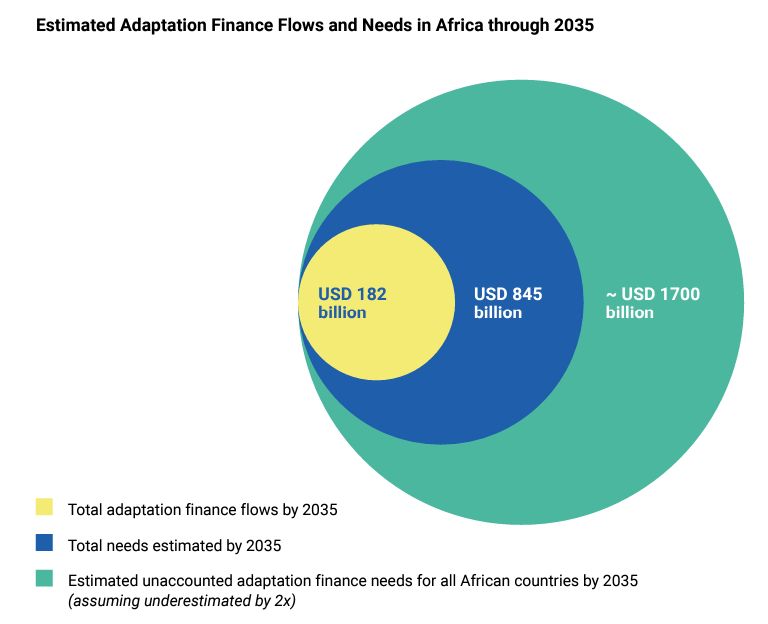
Recent data from Global Center on Adaptation shows that adaptation finance flows in Africa reached only USD 11 billion annually in 2019-2020. While there may be a modest increase in 2021-2022, more is needed. African NDCs estimate that the continent needs USD 53 billion annually for adaptation. However, new research suggests that the actual need could be as high as USD 100 billion annually.
This means that by 2035, Africa may require as much as USD 845 billion to 1.7 trillion for adaptation. At the current growth rate, Africa will receive only about USD 180 billion by 2035 – less than one-tenth of what is needed. Therefore, adaptation flows to Africa must increase 5–10-fold, from USD 11 billion to USD 53–106 billion annually.
The economic implications of failing to meet these adaptation investments could be staggering, with Africa potentially missing as much as USD 6 trillion of economic benefits by 2035. Furthermore, the majority of adaptation finance in Africa is channeled through loans, exacerbating the debt situation of many countries.
Every stakeholder must increase adaptation finance. Multilateral financial institutions, bilateral development finance institutions, philanthropies, and the private sector all have a role to play in increasing financing for adaptation. The private sector, in particular, has significant potential to increase financing for adaptation.
Bapon (SHM) Fakhruddin, PhD
Water and Climate Leader| Strategic Investment Partnerships and Co-Investments| Professor| EW4ALL| Board Member| Chair- CODATA TG| Award Winner (SDG 2021, EWS 2025)
Addressing the Adaptation Finance Gap in Africa

 Bapon (SHM) Fakhruddin, PhD